Before buying any botanical supplement, the label deserves more attention than the headline. This guide to Linfaflow ingredients looks at the four botanicals listed in the current product brief, what role each one is intended to play, how the liquid formula is used, and what safety questions are worth asking before you buy.
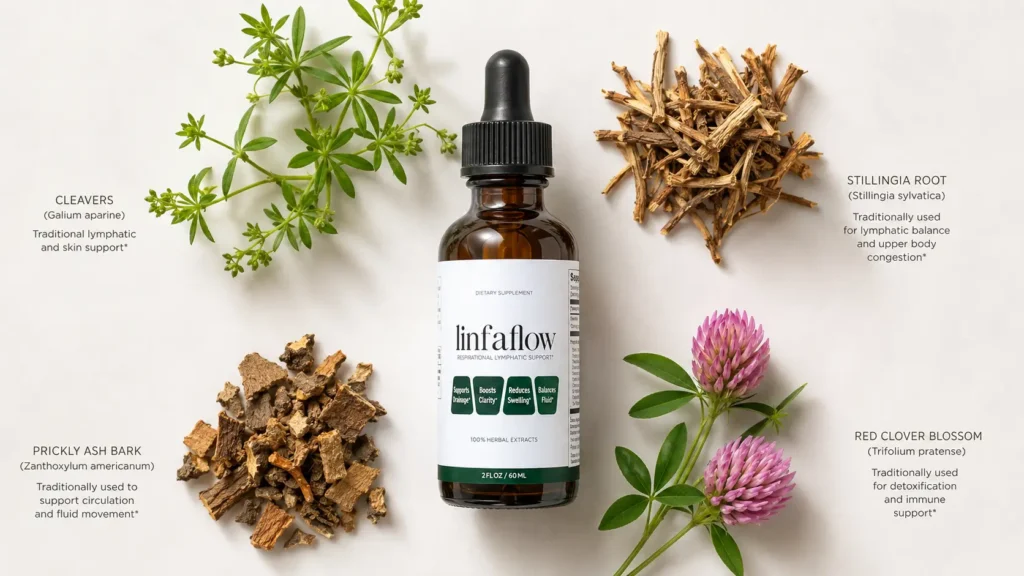
The current Linfaflow ingredients are Cleavers Aerial Parts, Stillingia Root, Prickly Ash Bark, and Red Clover Blossom.
The formula is sold as liquid drops and positioned as support for lymphatic flow, circulation, and normal fluid balance.
That is different from describing the product as a drug or treatment for edema, lymphedema, or another medical condition.
Table of Contents
What Are the Linfaflow Ingredients?
The official affiliate brief organizes the Linfaflow ingredients around complementary functions.
Instead of presenting one herb as the entire solution, the formula combines four botanicals intended to support circulation, fluid movement, drainage, and balance.
The four Linfaflow ingredients listed in the current brief are:
- Cleavers Aerial Parts
- Stillingia Root
- Prickly Ash Bark
- Red Clover Blossom
This four-ingredient structure is central to the product’s positioning.
The manufacturer describes Linfaflow as an “inside-out” daily routine for people concerned about puffiness, heavy-feeling legs, ankle sock marks, bloating, or discomfort after spending long periods sitting or standing.
If you are still deciding whether the overall supplement is right for you, see our complete Linfaflow reviews guide.
Cleavers Aerial Parts
Among the Linfaflow ingredients, cleavers is most closely associated in the product materials with lymphatic drainage and normal fluid movement.
Cleavers, botanically known as Galium aparine, has a history of traditional herbal use.
It is important to distinguish traditional use from proven clinical benefit.
The Linfaflow ingredients brief describes cleavers as part of the formula’s drainage-support role, but this does not mean the ingredient has been clinically proven to treat lymphedema or edema.
For buyers, the practical point is that cleavers is not presented as a conventional stimulant or pharmaceutical water pill. It is part of the botanical-support concept behind the formula.
Stillingia Root
Stillingia Root is another of the four Linfaflow ingredients.
In product materials, it is positioned as part of the “mobilize” stage of the formula, supporting movement through internal pathways and complementing cleavers.
Stillingia has historical use in American herbal traditions, but modern human research is limited.
That distinction matters when evaluating Linfaflow ingredients because marketing language should not be mistaken for evidence that a botanical can diagnose, treat, or cure a medical condition.
In practical terms, Stillingia Root helps broaden the formulation beyond a single botanical and supports the product’s multi-step positioning.
Prickly Ash Bark
Prickly Ash Bark is presented as the circulation-oriented component of the Linfaflow ingredients.
The product brief connects it with supporting circulation and helping “awaken” internal movement before the formula’s other botanicals perform their complementary roles.
For someone researching Linfaflow ingredients, this is an important distinction.
The formula is not simply four herbs marketed for exactly the same purpose. Each botanical is assigned a different role within the overall circulation-and-fluid-support concept.
This should still be understood as the manufacturer’s formulation rationale rather than proof that Prickly Ash Bark treats venous disease or another circulatory disorder.
Red Clover Blossom
Red Clover Blossom is probably the member of the Linfaflow ingredients list for which consumers can most easily find modern safety information from a major U.S. health agency.
The National Center for Complementary and Integrative Health explains that red clover contains isoflavones that are structurally similar to estrogen. It also notes that evidence has not established conclusive benefits for any health condition. NCCIH: Red Clover — Usefulness and Safety
That context is important when reviewing Linfaflow ingredients.
“Natural” does not automatically mean appropriate for every person.
NCCIH advises people taking medication to discuss herbal products with a healthcare provider and states that red clover supplements may be unsafe during pregnancy or breastfeeding.
Why Does Linfaflow Use Liquid Drops?
The format is one of the most practical differences between Linfaflow ingredients and many botanical blends sold in capsules.
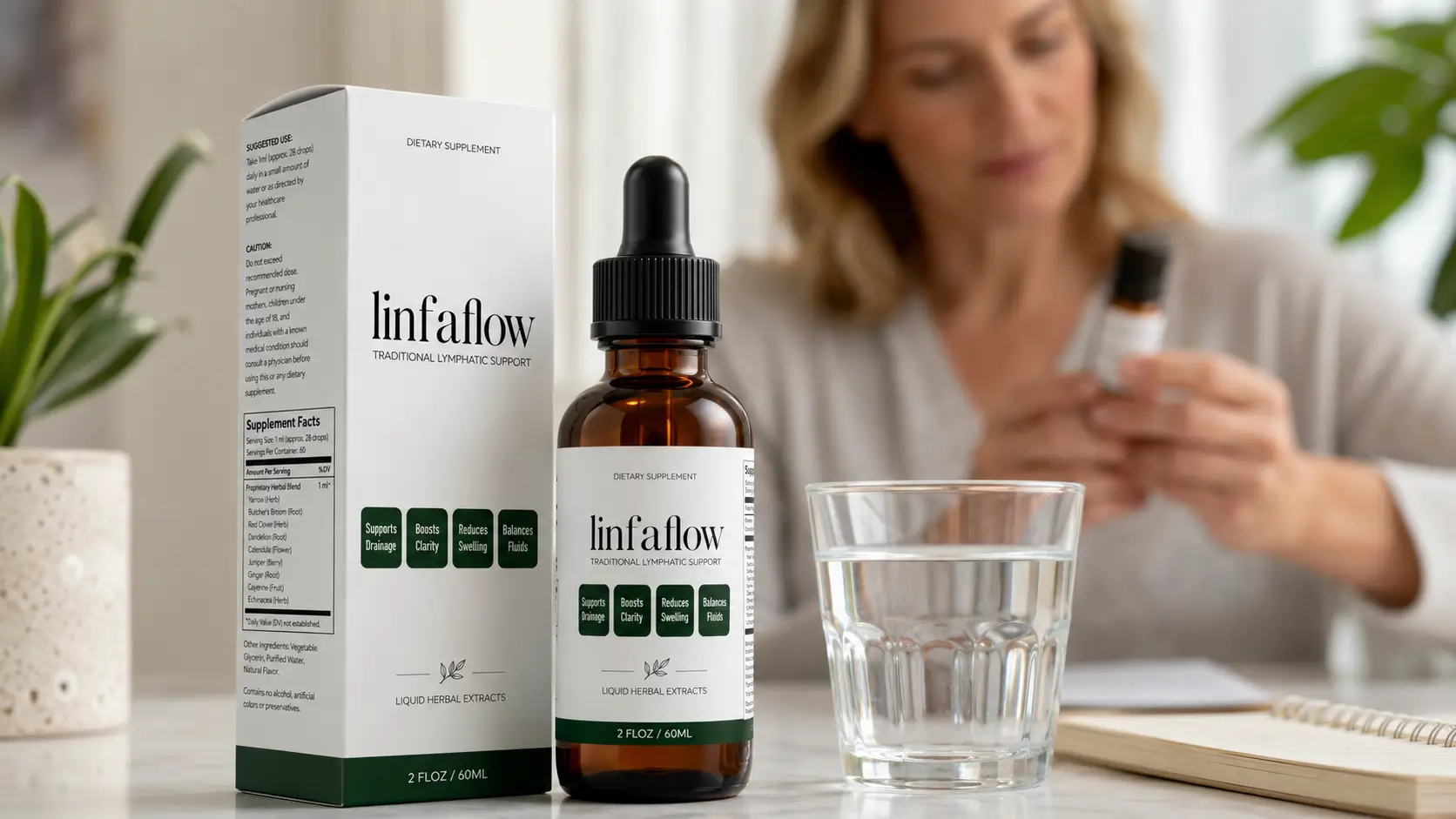
The current affiliate brief describes a serving as one dropper, approximately 1 mL, twice daily, generally morning and evening. One bottle is described as roughly a 30-day supply.
The company positions the liquid format as a simple daily ritual.
For consumers who dislike swallowing capsules or following complicated cleanse protocols, convenience may be one of the product’s strongest practical benefits.
Liquid delivery, however, should not automatically be interpreted as evidence that the Linfaflow ingredients are more effective than the same botanicals in every other delivery format.
Effectiveness can depend on the actual formulation, dose, quality, individual user, and intended outcome.
Are There Linfaflow Side Effects?
A responsible review of Linfaflow ingredients should not claim that botanical supplements are incapable of causing side effects or interactions.
The FDA advises consumers to discuss supplement use with a doctor, pharmacist, or other healthcare professional, particularly when medications or medical conditions are involved. FDA: Using Dietary Supplements Safely
Red clover deserves particular attention because it contains isoflavones.
Pregnancy, breastfeeding, hormone-sensitive conditions, medications, and other individual health factors may change whether a botanical formula is appropriate.
If you experience a new or concerning symptom after starting any supplement, stop using it and seek appropriate professional advice.
Is Linfaflow FDA Approved?
No dietary supplement should be described as FDA-approved for safety and effectiveness before marketing.
The FDA states that dietary supplements are regulated differently from drugs and generally are not approved before being sold to consumers. FDA: Is It Really FDA Approved?
This distinction is useful when comparing Linfaflow ingredients or any competing supplement.
A statement such as “manufactured in an FDA-registered facility” is not equivalent to saying that an individual dietary supplement is “FDA approved.”
A stronger buying decision instead considers the ingredient list, label, manufacturing information, directions, return policy, and whether the formula fits the individual’s circumstances.
Linfaflow Ingredients: Are They Worth Considering?
The appeal of the Linfaflow ingredients is the four-botanical structure: Cleavers Aerial Parts, Stillingia Root, Prickly Ash Bark, and Red Clover Blossom in a liquid formula designed around lymphatic, circulation, and fluid-balance support.
For shoppers who prefer botanical liquids rather than capsules, the format is straightforward and the formulation concept is easy to understand.
The limitation is equally important: this is a dietary supplement, not medical treatment, and evidence regarding individual botanical ingredients should not be exaggerated.
For that reason, our assessment of the Linfaflow ingredients is less about finding a “miracle herb” and more about determining whether the complete formulation, format, intended use, and safety considerations match what you want from a daily supplement.
If they do, the next step is to check the current product label, price, packages, refund policy, and purchasing options directly from the product source.
Still deciding? Our Linfaflow reviews guide covers the product as a whole, including pros, cons, who it may be for, and how it compares with other approaches. See also why the best supplements for swollen legs and ankles
What are the main Linfaflow ingredients?
The current affiliate brief lists four primary botanicals: Cleavers Aerial Parts, Stillingia Root, Prickly Ash Bark, and Red Clover Blossom.
Does Linfaflow contain red clover?
Yes. Red Clover Blossom is one of the four botanicals listed in the current Linfaflow formula materials.
Is Linfaflow safe?
A universal safety claim cannot be made for any botanical supplement. Individual medications, conditions, allergies, pregnancy, breastfeeding, and other factors can matter. Consult a healthcare professional when appropriate.
Can Linfaflow interact with medications?
Botanical ingredients can potentially interact with medications. NCCIH specifically advises people taking medication to discuss herbal products with their healthcare provider.
Is Linfaflow FDA approved?
No dietary supplement is FDA-approved for safety and effectiveness before marketing in the same way as a prescription drug. FDA facility registration should not be confused with product approval.
How do you take Linfaflow?
The current affiliate brief describes one approximately 1 mL dropper twice daily. Check the actual product label before use because instructions can change.
Where can I see the complete Linfaflow review?
Read our complete Linfaflow reviews article for the product’s intended use, pros, cons, comparisons, and buyer considerations.
Where can I buy Linfaflow?
Current pricing, packages, shipping, and refund terms can be checked directly on the offer page:
Check the current Linfaflow offer