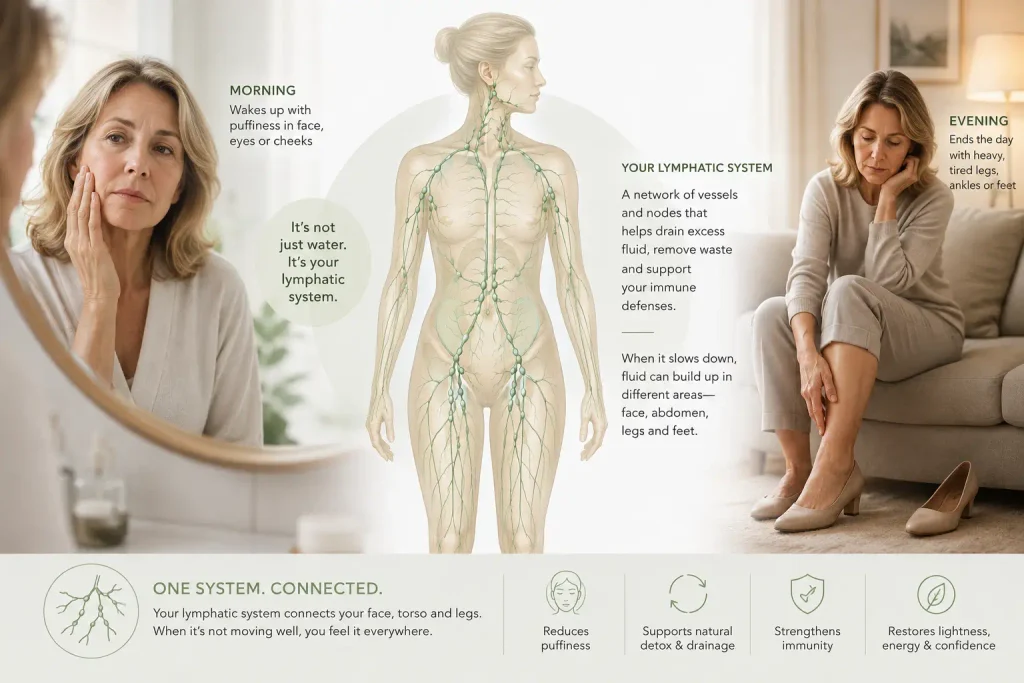
If you are wondering how to support lymphatic drainage naturally, you are probably not thinking about anatomy. You are thinking about how your body actually feels.
Maybe your legs feel heavier after a day at work. Your socks leave marks around your ankles. Your face looks puffier some mornings. Or sitting through a long flight leaves your lower legs feeling uncomfortable and tight.
Understanding how to support lymphatic drainage naturally starts with one basic fact: the lymphatic system is part of the body’s normal fluid-management network, and unlike the cardiovascular system, it does not have a central pump like the heart.
Movement and normal muscle contractions help move lymph through lymphatic vessels.
That makes lifestyle especially relevant — but it also means persistent swelling should never automatically be blamed on “poor lymphatic drainage.”
Table of Contents
What Does the Lymphatic System Do?
Before looking at how to support lymphatic drainage naturally, it helps to know what the system actually does.
The lymphatic system collects excess fluid from tissues and eventually returns it to the bloodstream. It is also an important part of immune function.
Cleveland Clinic explains the system in more detail here:
The Lymphatic System
Problems with fluid movement can have many causes, including medical conditions that have nothing to do with lifestyle.
If swelling appears suddenly, affects only one side, causes significant pain, or occurs with shortness of breath, medical evaluation is more important than trying another home remedy.
For everyday wellness, however, there are several practical approaches worth considering.
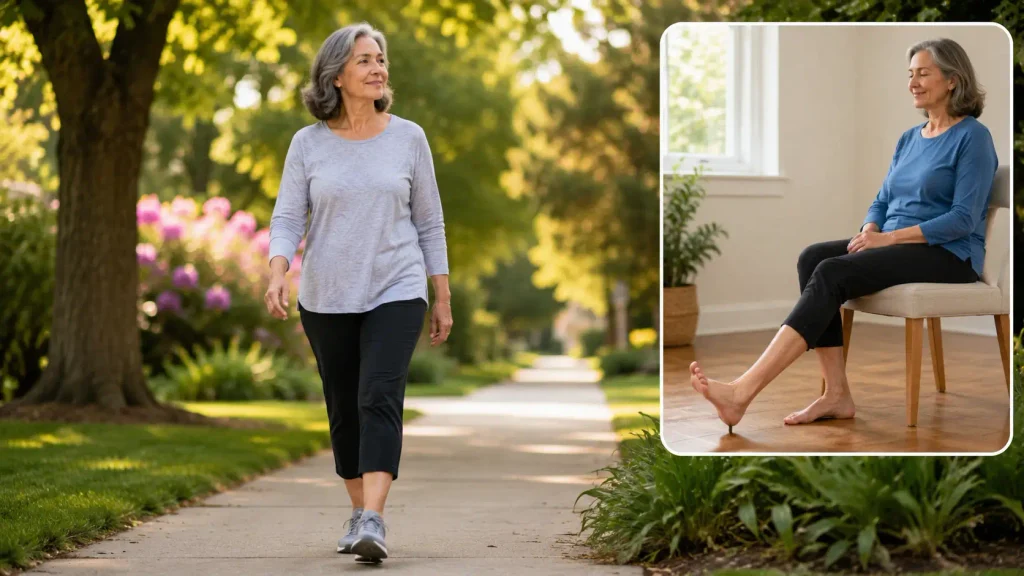
1. Walk and Move Throughout the Day
The simplest answer to how to support lymphatic drainage naturally is movement.
Walking causes muscles — particularly in the legs — to contract repeatedly. These contractions help support circulation and normal movement of fluid.
You do not necessarily need an intense workout.
If you spend eight hours at a desk, getting up periodically and walking for a few minutes may be more relevant to fluid movement than doing one workout and remaining seated the rest of the day.
The same principle applies to long flights and road trips.
Instead of thinking only about exercise, think about avoiding long uninterrupted periods of immobility.
2. Use Gentle Leg Movement When Sitting
For people researching how to support lymphatic drainage naturally because their legs feel heavy after sitting, simple ankle and calf movements can be useful additions to the day.
Examples include:
- flexing and pointing the feet;
- ankle circles;
- gently raising the heels;
- brief walking breaks;
- alternating between sitting and standing.
These are not treatments for edema or lymphedema.
They are simply ways to introduce more muscular movement into otherwise sedentary periods.
3. Stay Adequately Hydrated
Hydration is frequently mentioned when discussing how to support lymphatic drainage naturally, but the advice is often oversimplified.
Drinking huge quantities of water will not “flush” the lymphatic system.
The more reasonable goal is adequate hydration as part of normal physiological function.
Your individual fluid needs depend on body size, activity, environment, diet, medications, and health conditions.
People who have been given medical fluid restrictions should follow their healthcare provider’s advice rather than generic online hydration recommendations.
4. Consider Leg Elevation
Another common method for people learning how to support lymphatic drainage naturally is temporarily elevating the legs.
Gravity can contribute to fluid collecting in the lower body after prolonged standing or sitting.
Elevating the legs may therefore help some people feel more comfortable after a long day.
The limitation is important: elevation does not tell you why swelling is occurring.
If you need to elevate your legs constantly because swelling repeatedly returns or progressively worsens, that pattern deserves medical attention.
5. Learn When Compression Makes Sense
Compression frequently appears alongside discussions of how to support lymphatic drainage naturally because compression stockings apply controlled pressure to the lower legs.
They are widely used in different circulatory and swelling-related situations.
However, compression is not appropriate in exactly the same way for every person.
A clinician can help determine whether compression is suitable and what pressure level makes sense for a particular situation.
For general readers, the important distinction is that compression works externally.
That differs from lifestyle strategies or supplements intended to support normal physiological processes internally.
6. Consider Manual Lymphatic Techniques Carefully
Massage is another popular answer to how to support lymphatic drainage naturally.
Manual lymphatic drainage is a specific technique designed to encourage movement of lymphatic fluid and is commonly associated with trained practitioners.
It should not be confused with simply pressing aggressively on swollen tissue.
People with diagnosed lymphedema or significant swelling may benefit from professional guidance rather than attempting random techniques found on social media.
For everyday wellness, gentle massage may feel relaxing, but stronger claims about “detoxing” the body should be treated skeptically.
7. Explore Botanical Lymphatic-Support Supplements
For some consumers, researching how to support lymphatic drainage naturally eventually leads to herbal supplements.
These products typically combine botanicals traditionally associated with lymphatic support, circulation, or fluid balance.
One example is Linfaflow, a liquid supplement containing:
- Cleavers Aerial Parts
- Stillingia Root
- Prickly Ash Bark
- Red Clover Blossom
The product is positioned as a daily botanical routine supporting normal lymphatic flow, circulation, and fluid balance.
It is not a treatment for edema or lymphedema.
If you are specifically researching supplements, our guide to the best supplements for swollen legs and ankles compares the categories and explains what to look for.
For readers who already know about Linfaflow, our Linfaflow reviews go deeper into the product, formula, advantages, and limitations.
What About Dry Brushing?
Dry brushing regularly appears in social media content about how to support lymphatic drainage naturally.
The practice involves brushing the skin using a dry, typically firm-bristled brush.
Some people enjoy it as part of a personal-care routine, but claims that dry brushing “detoxifies” the body or medically treats lymphatic dysfunction are much stronger than the available evidence supports.
If you enjoy dry brushing and it does not irritate your skin, it may fit into a wellness routine.
It should not replace appropriate evaluation for ongoing swelling.
Can Diet Improve Lymphatic Drainage?
Diet is another area where advice about how to support lymphatic drainage naturally can quickly become exaggerated.
There is no single “lymph detox diet.”
A generally balanced eating pattern, appropriate sodium intake, hydration, movement, and weight management may all contribute to overall cardiovascular and metabolic health.
Extreme cleanses and aggressive restriction are not necessary for the lymphatic system to perform its normal functions.
If certain foods repeatedly coincide with bloating or digestive symptoms, that is a separate issue worth evaluating rather than assuming every instance of puffiness comes from the lymphatic system.
How Do You Know Which Approach to Try?
The most useful way to think about how to support lymphatic drainage naturally is to match the strategy to your situation.
If you sit for long periods, start with movement.
If your discomfort happens primarily after standing, changing position, walking, or appropriate compression may be relevant.
If you are interested in an internal wellness approach, a botanical lymphatic-support supplement may be worth researching.
And if the swelling is persistent, worsening, unexplained, painful, or accompanied by other symptoms, finding the cause is more important than trying to “drain” it yourself.
For readers who have moved beyond lifestyle research and want to compare supplement options, continue with our guide:
See the best supplements for swollen legs and ankles
If Linfaflow is the option you are already considering, you can also check the current product packages directly:
What is the easiest way to support lymphatic drainage naturally?
Regular movement is one of the simplest lifestyle strategies because muscle contractions contribute to normal movement of fluid through the body.
Does drinking water improve lymphatic drainage?
Adequate hydration supports normal body function, but drinking excessive water does not “flush” or detoxify the lymphatic system.
Does walking help lymphatic drainage?
Walking activates the muscles of the legs and can support normal circulation and fluid movement, particularly compared with remaining sedentary for long periods.
What foods cleanse the lymphatic system?
There is no scientifically established “lymph cleanse” food or diet. A balanced diet and appropriate hydration are more reasonable strategies than extreme cleanses.
Do lymphatic supplements work?
Some botanical supplements are marketed to support normal lymphatic flow and fluid balance. They should not be considered treatments for lymphedema or medical causes of swelling.
What is a lymphatic-support supplement?
These products commonly contain botanicals associated with circulation or traditional lymphatic support. Linfaflow, for example, combines Cleavers, Stillingia Root, Prickly Ash Bark, and Red Clover Blossom.
What supplement should I consider?
See our best supplements for swollen legs and ankles guide for a comparison of the main product categories.
Where can I learn more about Linfaflow?
Our Linfaflow reviews explain its formula, intended use, advantages, limitations, and who may want to consider it.